


Digital calibration certificates: what the lab gains
What a calibration lab gains from issuing digital calibration certificates (DCC): fewer queries, reusable data, checkable conformity, first steps.
Also available in: Deutsch
Most calibration laboratories still deliver their results the way they did twenty years ago: as a PDF, often with a scanned signature, sent by e-mail. The customer prints it, files it and types the numbers they need into a spreadsheet or a CAQ system. A digital calibration certificate (DCC) replaces that PDF with a structured XML file that software can read directly. The case for it is usually made from the customer's side. This post makes it from the laboratory's side: what a lab gains from issuing DCCs, where the effort really lies, and how to take the first steps with the PTB schema.
What a PDF certificate costs the laboratory
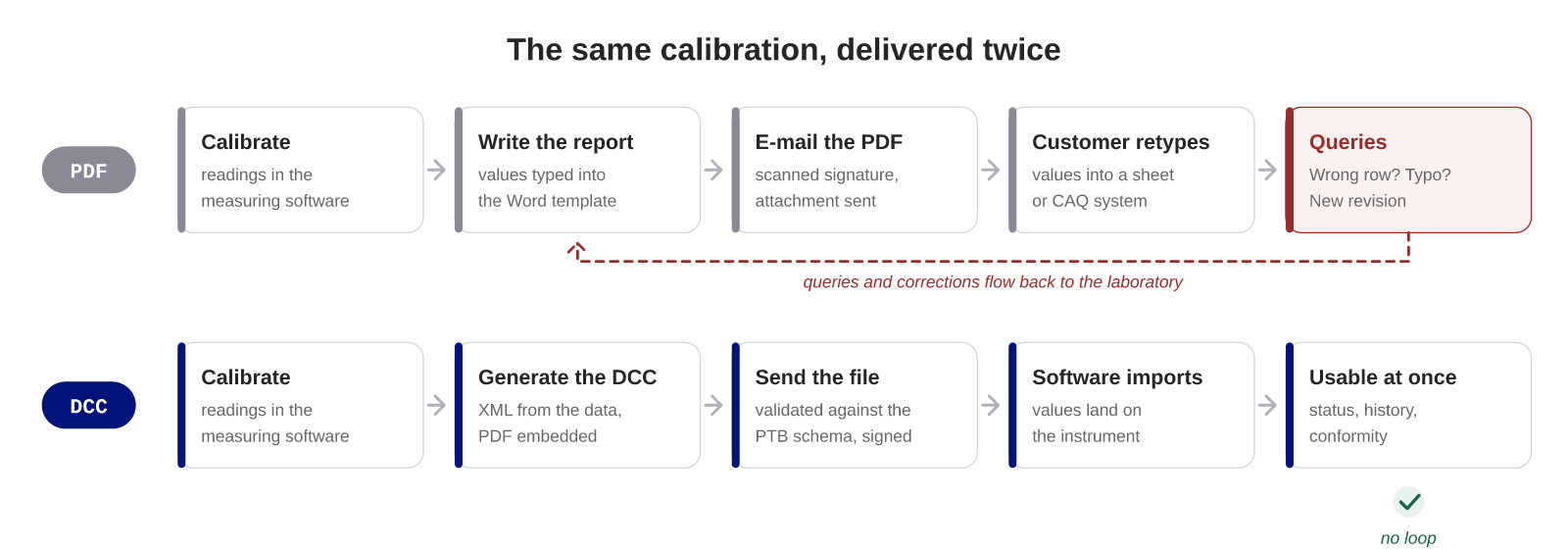
The PDF seems free. It is the lab's own report, generated anyway. The costs appear later, and they rarely show up in the lab's accounting:
- Queries. A customer cannot find the uncertainty for one measuring point, reads a value from the wrong row or wonders whether "as found" or "as left" is meant. Each question is an e-mail, a look-up and an answer from someone who could be calibrating instead.
- Retyping, on both sides. The customer types your values into their system. If they make a mistake, your certificate is "wrong" until someone compares the two. Inside the lab, data often travels from the measuring software into a Word template by hand as well.
- Re-issues. A typo in a serial number or a customer name means a corrected certificate, a new revision, and the question which of the two is now valid.
- Locked results. Years of measurement data sit in PDFs where nobody can analyse them: not the customer, who wants to see the drift of an instrument, and not the lab, which could use the same history to advise on calibration intervals.
None of these costs is large on its own. Together they are a steady drain on exactly the people whose time the laboratory sells.
Five things a lab gains from issuing DCCs
1. Fewer queries and no retyping
A DCC states every value with its unit, its uncertainty and the condition it was measured under, in fields defined by the schema. There is no row to misread and nothing to type off. The customer's software imports the certificate, and the values land next to the instrument they belong to. Most of the e-mails that today begin with "a quick question about certificate number ..." do not get written.
2. Measurement data the customer can reuse, and so can you
Once results are structured, they can be compared. The customer sees the drift of an instrument across its last five calibrations and can justify the interval with data, which is exactly what an auditor asks for (we covered this in our post on preparing instruments for an audit). The laboratory holds the same history and can offer it as a service: an interval recommendation based on the instrument's own behaviour instead of a rule of thumb. That is a conversation a PDF archive cannot start.
3. Conformity statements that a machine can check
A statement such as "within the manufacturer's specification" or "conforms to class 1" is the part of the certificate most customers actually act on. In a DCC it is a structured element, linked to the measuring points and the decision rule it was based on, not a sentence in a footer. The customer's system can read it, set the instrument's status accordingly and raise a flag when a result is out of tolerance. For the lab this means fewer misunderstandings about what was and was not assessed.
4. A differentiator in tenders and customer audits
Framework agreements and tenders increasingly ask how calibration data is delivered. Companies that are building a digital quality record do not want to retype certificates from one supplier while importing them from another. Being able to answer "we deliver DCCs according to the PTB schema, with an embedded PDF and a digital signature" sets a laboratory apart in a market where price and turnaround time are otherwise hard to distinguish. The same holds in the customer's audits: a validated DCC linked to the instrument is the kind of evidence an auditor can check in seconds.
5. One source for PDF and XML
The gain inside the lab is less visible but just as real. A DCC is generated from the measurement data, and the PDF can be generated from the same data and embedded in the DCC. The report is no longer assembled by hand, numbers are not copied twice, and a corrected certificate is a regenerated file instead of an edited document. Laboratories that take this step usually find that their internal error rate drops before the first customer has even asked for a DCC.
What a DCC is, in short
The DCC format was developed by the Physikalisch-Technische Bundesanstalt (PTB), Germany's national metrology institute, with partners from industry and accredited laboratories. It is an XML schema with two main parts: administrative data (laboratory, accreditation, customer, item, responsible persons, statements) and measurement results (quantities, reference values, deviations and uncertainties, with units in the machine-readable D-SI notation). Optional parts carry the human-readable PDF and a digital signature. We explain the structure in detail in Reading a digital calibration certificate.
First steps with the PTB schema
The effort is in the mapping, not in the technology. These steps have worked for laboratories that started from scratch:
- Get the schema and the examples. PTB publishes the DCC XML schema (XSD), its documentation and example certificates. Read the examples before the schema; they show how the fields are meant to be used.
- Pick your most frequent certificate type. One instrument class, a few measurands. Map each field of your current report to an element of the schema: the administrative block first, then the results. Note the units as D-SI expressions while you do it.
- Generate from data, not from the PDF. Connect the export to the measurement data in your calibration software or database. A DCC that is transcribed from the finished PDF inherits every manual step you wanted to remove.
- Validate on every export. Check each file against the XSD before it leaves the lab. A DCC that does not validate is a support call waiting to happen.
- Embed the PDF. Generate the human-readable report from the same data and put it into the document element of the DCC. One file, two readers.
- Decide about the signature. Start without it in the pilot. When the export is stable, add an XML signature, with a qualified certificate if your customers or your accreditation body expect one.
- Give your customers a reader. Point them to the free DCC Viewer so the first DCC they receive is something they can open, check and export without installing anything.
- Pilot with one customer. Choose a customer who manages instruments in software and would benefit immediately. Their feedback on the first ten certificates is worth more than any internal review.
What your customers do with the DCC
A DCC is only as valuable as the software on the receiving end. Customers who manage their instruments in the digical app upload the DCC, have it validated against the official PTB schema, see the laboratory, accreditation and results as structured data, and keep the original file with the instrument's record. Over the REST API, certificates can also be created directly from the lab's system, which turns "send the certificate" into a single call. Every plan includes the full feature set; see the pricing page for details. And for everyone who does not use digical, the DCC Viewer remains free: a laboratory that issues DCCs can hand its customers a reader along with the first file.
Frequently asked questions
Is a DCC an accredited calibration certificate?
It can be. ISO/IEC 17025 clause 7.8 defines what a calibration certificate must contain, not what it must look like. A DCC that carries the required content and is issued under the laboratory's management system is a calibration certificate like any other. Ask your accreditation body how it wants the accreditation symbol and the signature handled in a digital certificate; DAkkS, for example, publishes information on this.
Do we have to stop sending PDFs?
No. The DCC schema has a document element that carries the human-readable PDF inside the XML file, so one file serves both the reader and the software. Many laboratories send both files side by side during the transition and switch to the DCC alone once their customers are ready.
Does a DCC need a digital signature?
The schema does not require one, and an unsigned DCC is already useful for data exchange. A signature proves who issued the file and that it has not been changed since. If your customers are audited on the authenticity of certificates, or if your accreditation body expects it, use an XML signature based on a qualified certificate. Most laboratories pilot without a signature and add it once the export is stable.
Which software produces a DCC?
Any software that can write XML. Several calibration-management and measurement packages offer a DCC export, PTB publishes tools and example code, and a laboratory with its own report generator can add a DCC output to it. The important part is that the DCC is generated from the measurement data, not transcribed from the finished PDF.
How long does it take to issue the first DCC?
For one certificate type with a few measurands, the mapping to the schema and a validated export are a matter of weeks, not months. Covering every certificate type the laboratory issues takes longer, which is why starting with the most frequent one pays off.
What do our customers need to read a DCC?
Nothing to install. The free DCC Viewer opens any DCC in the browser without an account and exports a readable PDF. Customers who manage their instruments in digical upload the DCC there and have it validated, linked to the instrument and stored with the original.